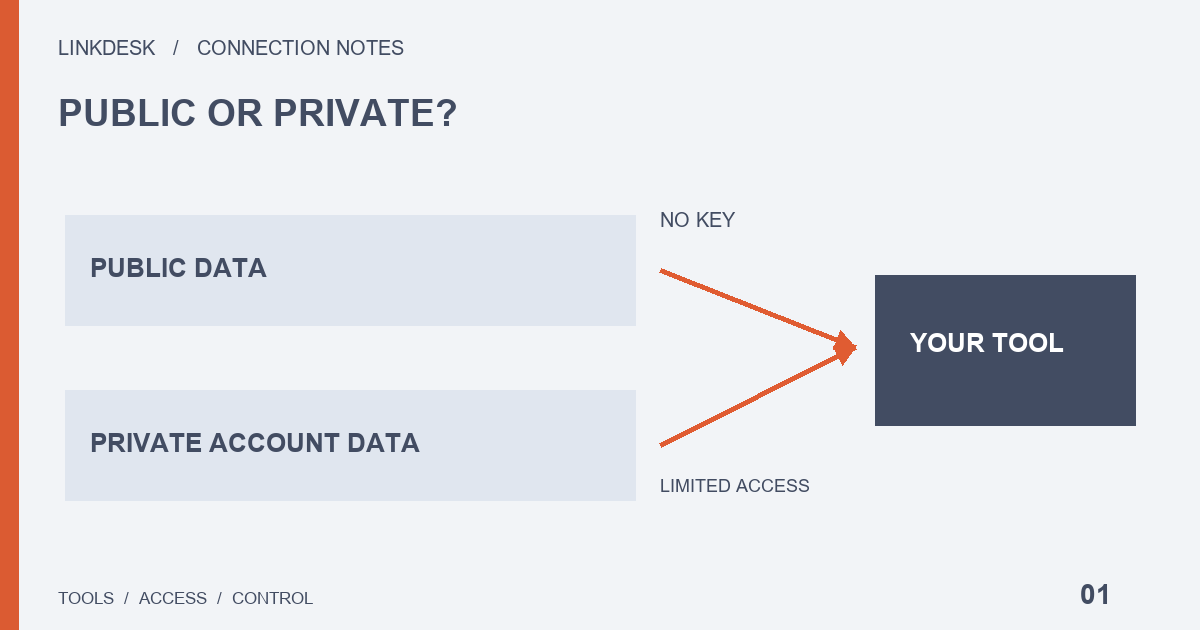
Public prices usually need no account key. Reading private balances and executing trades are separate tasks with different access requirements.
Describe the task first
“Show the public BTC price on my desktop” is different from “show the assets I hold.” One uses public market data; the other exposes personal account information. Write down the feature you want before accepting the tool’s default permission selection.
Three tasks, three paths
For public prices, look for public data endpoints. For portfolio synchronization, check whether read-only account endpoints cover the required records. Executing trades requires trading access. A tool can cause losses through incorrect or malicious trades even when withdrawals are disabled. Assets staying on an exchange is not proof of safety.
Four checks before connecting
Confirm the supported Binance entity and environment, read the tool’s official connection instructions, list the private information it needs and find the revocation process. For example, a balance dashboard asking to trade and withdraw requires an explanation from its provider before you proceed.
If you do not have an account
Check that both the tool and the exchange service are available for your actual residence before registering. An invitation benefit does not establish compatibility. Existing users do not need a new account to troubleshoot: begin with account, environment, permissions and IP checks.
Compare pages, exports and persistent access
An occasional price check may be served by a public page. A monthly report may be easier to maintain through an official export. A continuously updated application may justify an interface. Compare these ways of completing the same task before treating API access as a necessary milestone.
Consider frequency, acceptable manual work, required records and maintenance effort. A daily dashboard and an annual summary do not necessarily need the same arrangement. Exports still need careful storage and sharing. Their difference is that you can choose a particular set of records for one handover, whereas a connected service may keep operating when you are not viewing it.
Four examples with different boundaries
A desktop price alert can begin with public prices. A personal allocation chart needs private information, but that does not automatically justify changing positions. A collaborator preparing a monthly report may need only a summary rather than a credential. Software intended to execute actions is a separate decision requiring operating controls and a clear stopping route.
Ignore broad labels such as “smart” or “professional” while defining the task. Rewrite the feature with concrete verbs: display, read, summarize, send or change. When the verb changes, the required connection may change too. This makes it easier to question a package that bundles capabilities you do not plan to use.
Account creation does not establish compatibility
Check demonstrations, supported account entities, service eligibility and permission requirements before registering because of a tool. An invitation benefit cannot answer those questions. Existing users should not repeatedly create accounts to diagnose a connection; begin with environment, connection method, version and the observed error.
Keeping a manual method is also a valid decision. If monthly work becomes frequent enough that automation has clear value, reassess the new frequency and information scope then. You do not need to authorize a hypothetical future feature today.
Ask a question that needs no credentials
Tell support: “I need a weekly balance summary without execution. Does your product support this completely in read-only mode, what information reaches your servers, and how do I revoke access?” The question describes your purpose while requiring no account secret.
Save the answer and its applicable version. A performance chart or a request for credentials does not settle compatibility. Return to three questions: does the task need private records, does it need continuing updates, and does it need to change account state? Those answers determine whether to continue with permission review, connection preparation or a simpler method.