Read-only access limits actions, not every privacy consequence. Revocation stops future authorized access through that credential; existing copies require a separate retention and deletion review.
Start from the screen you need
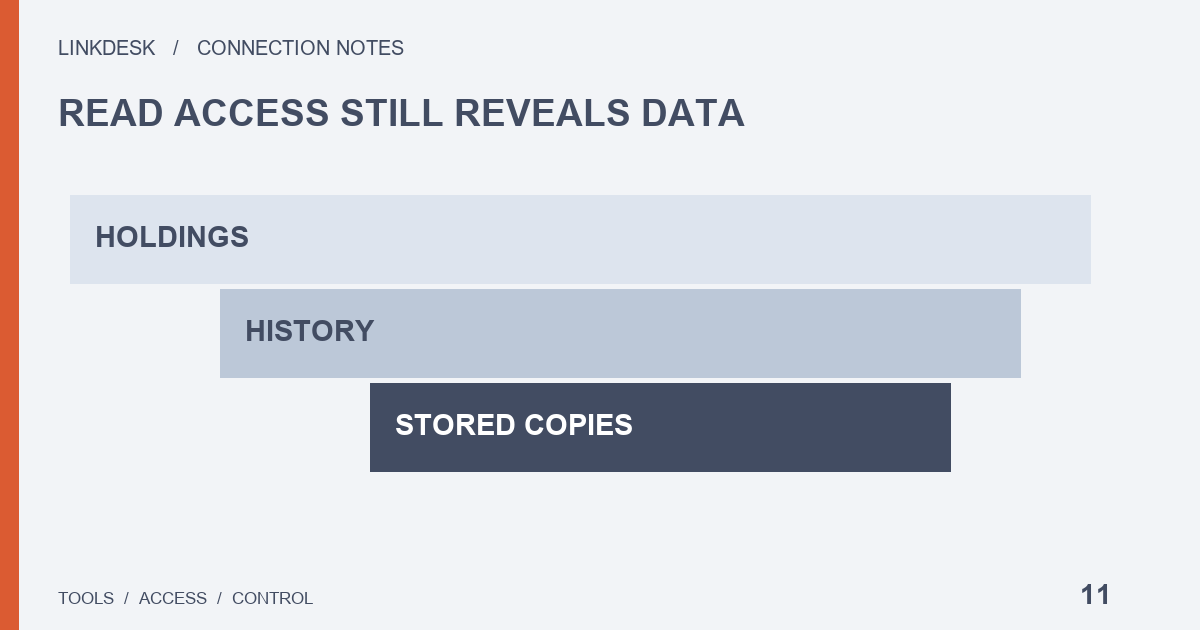
A simple allocation screen may need asset names and balances. A historical chart may also require snapshots or past records. List the features you want and ask the provider which fields support each one. “Analytics” is not an explanation for unlimited collection. Leaving an unnecessary feature disabled can reduce ongoing synchronization and make the eventual exit easier to understand.
Separate access from retention
API permission information describes what a credential may access. The provider’s data practices describe what happens afterwards. Both matter. Binance documents a permission-inspection endpoint, but ordinary users need not hand credentials to another website to inspect them. Review official account settings and the provider’s stated fields, purposes and retention periods. A read-only badge cannot answer all those questions.
Draw the copies
Consider a hypothetical path: an exchange response reaches a tool server, a database stores a snapshot, a browser draws a chart and the user exports a file. Ask whether each step leaves a copy. This is a question list, not an assertion that every provider works identically. A local-processing claim should explain which requests leave the device and what persists after browser data is cleared.
Minimize support evidence
Support commonly needs the affected feature, page and time, not your entire portfolio. Remove unrelated balances, account identifiers and email addresses from screenshots. Inspect logs for credentials, signatures and full private responses. A year of account history is rarely a sensible first troubleshooting attachment. If an export is requested, agree on the smallest necessary range and fields, official private channel and attachment handling.
Distinguish three exit actions
Stopping synchronization cancels a tool’s planned new work. Revoking the credential ends its subsequent authorization. A deletion request addresses copies the provider already holds. These actions cannot replace each other. Removing an app does not establish that cloud caches disappeared. An ordinary departure can track all three actions, while suspected credential exposure calls for revocation first rather than delaying to finish an export.
Ask for a concrete deletion result
Identify the connection, relevant data categories and features you want closed. Decide whether you need your own export. Ask the provider to explain the deletion scope, retained categories and reasons, handling process and confirmation channel. Do not assume every backup disappears physically at once. A missing page is not proof that all copies were handled. Applicable rights and limitations depend on the relevant rules and terms.
Contact the correct holder
Binance’s privacy portal explains requests relating to its own processing and retention limitations. It does not automatically delete an independent dashboard’s database. Contact the party holding the data through its official channel. Ending a dashboard connection normally does not require closing the whole exchange account. Conversely, account closure does not prove that a separate tool has no historical copies left.
Keep a non-sensitive exit record
Record the synchronization stop time, revoked label, deletion request reference and the scope of the response. Inspect scheduled emails, shared dashboards and automatic exports that might continue. Check whether old cached data is misleadingly presented as live. For local files you retain, know their location, access and purpose. The exit record needs no balances or detailed history; it documents when and how the relationship ended.
Review sharing and notifications
API access is only one data path. A tool may offer public dashboard links, collaborators, scheduled emails or automatic exports. Inspect those features separately. Stopping new synchronization may leave a final snapshot available through an old share link. A notification can disclose amounts on a lock screen even when the dashboard itself is closed. For a simple status need, check whether amount-free notifications are available. Your own downloaded files also become copies you control; a provider’s deletion process does not manage your email attachments or cloud backups. Include these paths in the exit inventory.