Uninstalling or signing out does not revoke API permissions. Handle the relevant key in official API Management and review tasks that may still be active.
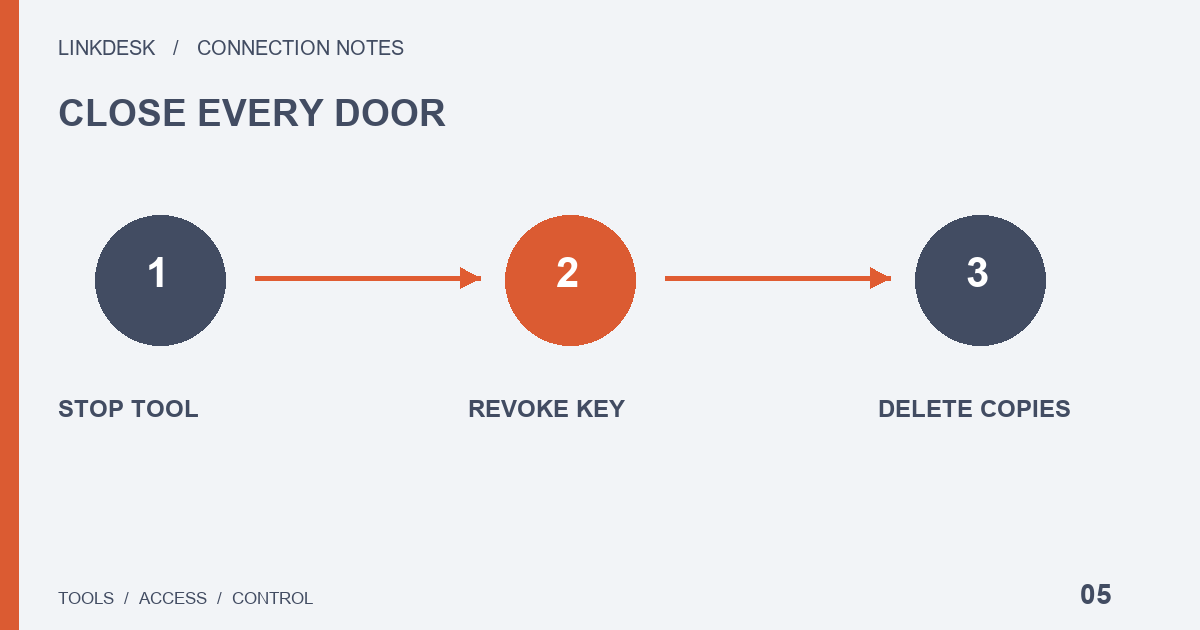
Three separate actions
Stopping a tool, revoking its platform key and deleting retained third-party data are different actions. Finishing one does not prove the other two are complete. Distinct key labels for different tools make it easier to remove one connection without disrupting another.
Revoke access on the platform
If a key may be exposed, revoke the affected key immediately in official API Management. For unusual account activity, follow official instructions to revoke access and contact support. For a normal departure, match the tool, label and purpose before revoking. Nobody needs your old secret to “verify closure.”
Check remaining platform state
Revocation does not undo completed trades. Nor should you assume every submitted operation disappears with the connection. Review relevant pending activity in the platform’s official interface. This guide separates removing access from handling account state; the platform determines order behavior.
Then handle provider data
Read the provider’s retention and deletion policy. Use its official process to disconnect, cancel a subscription or request data deletion. Keep a non-sensitive record of the revocation and review date. Reassess permissions and support before reconnecting later: past success does not prove current compatibility.
Choose the right priority for departure
A normal departure may follow a finished trial, changing tools or no longer needing reports. You can identify connections and dependencies before closing them. Suspected credential exposure is different: prioritize affected access and official guidance instead of waiting for a commercial cancellation process.
A failed dashboard alone does not establish exposure. Conversely, a working dashboard does not make a publicly posted secret trustworthy. Keep connection troubleshooting and exposure response separate. Records should support necessary action rather than delay it.
Identify what is still running
Match the provider, platform label, environment, location and purpose using non-sensitive records. A desktop installation may coexist with hosted tasks or another machine. Removing one local copy does not establish that every task stopped. Ask what the provider means by pause, stop, disconnect and delete.
If several tools shared one credential, identify the remaining legitimate uses. Do not indefinitely preserve unwanted access merely because another service depends on it. Use the supported replacement process to make the continuing connections independently manageable. The rotation guide addresses that separate task.
Track four outcomes independently
Track stopping tasks, revoking platform access, reviewing relevant platform state, and handling the provider account and data. Each can be complete or outstanding. Subscription cancellation may affect billing without removing an authorization. Revocation does not establish deletion of stored reports.
Use the official platform entry point to identify and revoke the correct access. Nobody needs your old Secret to verify closure. Inspect the visible management result without exposing credentials in a screenshot. When status is unclear, ask official support how to confirm it rather than inventing a live action as a test.
Separate data, billing and collaboration
Ask the provider about synchronized records, reports, shared links and retention rather than accepting one vague promise to delete everything. Review cancellation separately and keep its stated scope. Your own exports and collaborators’ copies may need independent handling.
For a team, distinguish member access to the tool, the tool’s platform access and access to reports. Removing one person does not settle every layer. Handover notes should identify continuing purposes, responsible people and outstanding tasks without distributing old credentials through chat.
Read the final state carefully
An “unconnected” icon does not prove that historical copies disappeared. Equally, a tool displaying an old balance does not prove continuing access; it may show retained data. Ask whether the record is cached, when it updated and what the platform management state shows.
Keep a non-sensitive closure record with each completed action and unresolved item. If you return later, review current compatibility and permissions rather than restoring every old setting. You can retain maintenance knowledge without retaining an idle credential. This distinction keeps documentation useful while access reflects the services you actually use.