Allow the trusted address that actually sends API requests. Your browser’s public IP is often different from a cloud provider’s outbound server address.
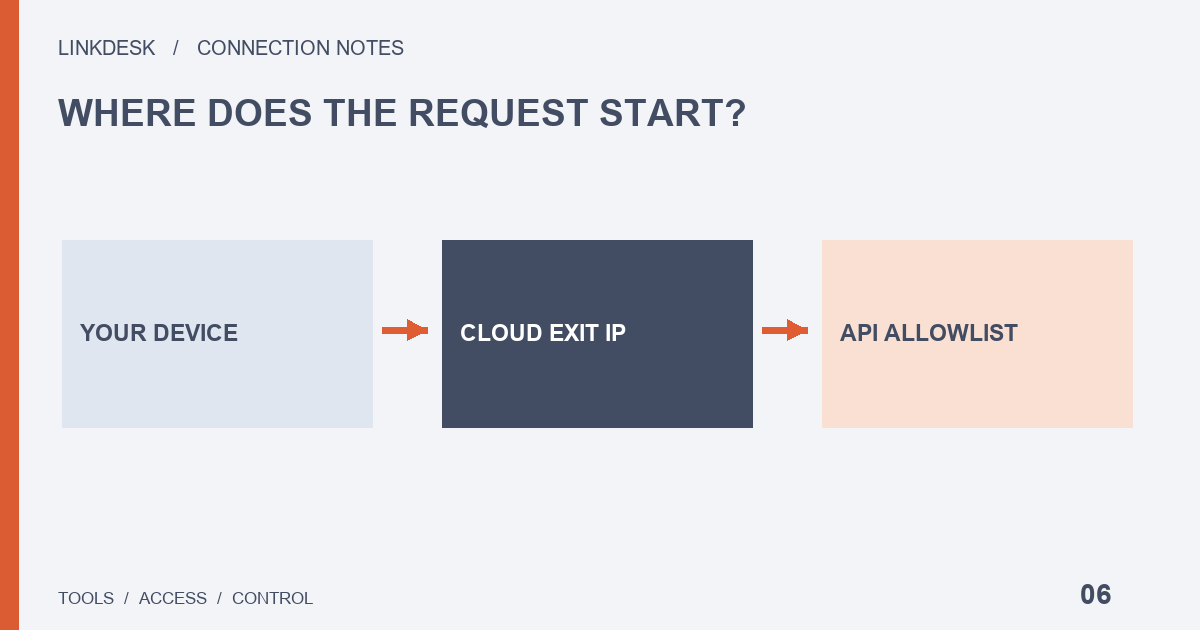
Trace the request, not the browser
Draw three boxes: your browser, the tool’s service and the exchange API. Clicking refresh may instruct the service to fetch data rather than make your browser fetch it directly. A desktop application can also rely on a remote backend. Ask where the account request runs and who operates that component. This small diagram determines who can provide meaningful evidence about the outbound address.
Keep the source with the address
Obtain the list from the verified provider website or its authenticated connection instructions. Record the document URL, review date, applicable region and product version. A copied community screenshot cannot establish that its addresses belong to your current service. Multiple addresses may support redundancy, but the provider should explain their role. Confirm discrepancies through an existing official support channel before adding anything.
Separate three different addresses
The server hosting a marketing website may not process account synchronization. A container address or home router address may also differ from the public egress observed by the exchange. For a managed product, request its documented outbound list. For your own program, inspect the path from the machine that runs it. The current Binance key-creation guide specifies IPv4 restrictions; follow the format accepted by your account interface.
Work through a migration example
Imagine a dashboard synchronized yesterday and now reports a connection failure. Check whether its operator moved servers, changed regions or replaced a fixed outbound connection. Ask which address the failed job used. Your ability to open the dashboard website does not answer that question. After verifying a change, update only the relevant allowlist entry. Keep the existing permissions so the result can be attributed to one change.
Confirm a fresh read
Use the tool to perform one authorized read operation after the change. Record the completion time and the age of the returned data. A green badge might reflect cached status. If it still fails, give support a redacted error category, environment and tool version. Invalid-key errors can involve IP restrictions, but the code alone does not establish that the allowlist caused this particular failure.
Plan for the next change
If the provider cannot explain its outbound addresses, decide whether the connection is maintainable before proceeding. Removing restrictions should not be the routine repair. Keep a separate key label and an official notification channel for each service. After migration, confirm that the old route is retired before removing obsolete entries. An allowed server can still run untrustworthy software: location restrictions do not replace appropriate access permissions.
Write a useful support request
Describe the read function that failed, the last successful time, any intervening network changes and the non-sensitive error. Identify the official document supplying the address list. Leave out credentials, complete signed URLs and private balances. This gives the operator a precise question about its infrastructure instead of inviting a vague instruction to reconnect everything. Close the issue only after a newly completed synchronization is visible.
Distinguish network failure from rejection
Ask whether the application actually received an upstream status code. A failure before a network connection is established supplies little evidence about an API allowlist. The operator should distinguish that from a received authentication error. Intermittent success also deserves a node check: one job may use an allowed primary server while another uses a different backup route. Do not collect every address ever associated with the provider. Request the current supported set and its change process. A verified list and observed fresh reads are more useful than a growing collection of guesses.