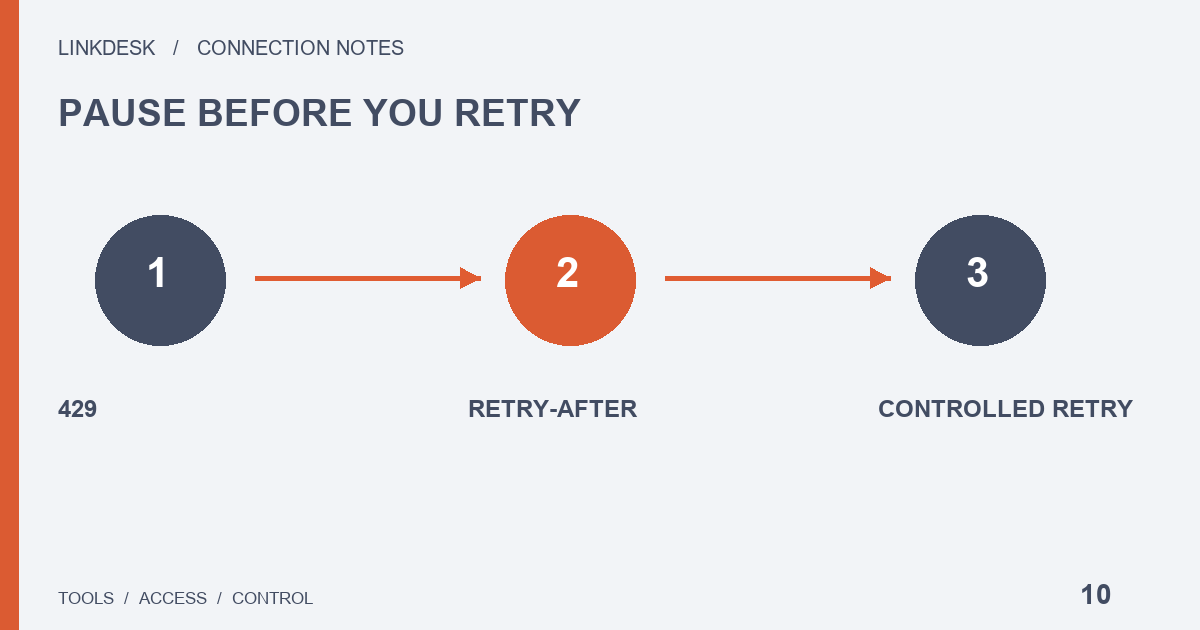
A 429 response signals a rate limit. Preserve the waiting information, pause related retries and coordinate other jobs sharing the outbound connection.
Do not click refresh again
A stalled synchronization invites repeated clicks. Once a 429 is known, pause automatic retries and repeated manual triggers. Record the occurrence time and whether Retry-After was present. A managed tool should communicate a waiting state rather than only spin indefinitely. Ask whether requests have actually paused and what condition will permit another attempt; users should not have to guess a current exchange threshold.
Read the current response
The Binance REST reference describes Retry-After on 429 and 418 responses as a wait in seconds. A value from yesterday is not a permanent countdown. A tutorial example is not your current response. If the interface hides this information, request a redacted status from its maintainer. Missing visibility does not mean that an immediate retry is permitted or useful.
Consider the whole outbound path
A cloud service can combine many users and background jobs behind one outbound address. Your own infrequent refresh might coincide with concentrated activity elsewhere. Some REST capacity is measured by IP, so replacing a credential does not solve that shared workload. Ask the operator which limiter was reached and which job group consumes the budget before assuming an individual user refresh caused everything.
Separate imports from updates
Consider a scheduling design rather than a fixed exchange setting: queue a first historical import in controlled segments, while daily refreshes request new ranges and reuse still-valid results. These jobs should not blindly compete with identical polling schedules. The maintainer needs endpoint-specific costs and a saved progress position. Otherwise, every failure may restart a large import from its earliest date and waste the same work.
Choose one retry owner
A browser, service, queue and network library may each retry independently. A few attempts at every layer can combine into substantial duplication. Decide which component owns the next attempt and how the others receive a pause. On recovery, avoid launching every waiting job together. Stagger scheduling and define attempt limits and stop conditions. This is an implementation proposal to validate, not a claimed exchange requirement.
Classify other failures separately
A timing error, invalid signature or missing read permission requires its own correction. Waiting repeatedly does not make those configurations correct. Network interruptions and server errors form other categories. This guide concerns connection and reading tasks, not automatic replay of trading requests. Keep HTTP status distinct from API error categories so operators know whether to wait, correct a configuration or seek support.
Inspect the backlog before recovery
After the waiting condition is satisfied, use one controlled necessary read to inspect the state, then restore jobs gradually. Watch data age, queue size and rate-limit categories. If the same limit immediately returns, stop the loop and review the shared budget. Continuing violations can escalate to an IP ban. Repeated key changes or address switching are not substitutes for correcting the workload.
Collect evidence without adding load
Users can record the last success, first failure, manual refresh count and whether a historical import was running. Note whether other pages in the same tool stopped updating. Do not increase request frequency to gather proof. Maintainers should retain redacted wait boundaries, job identifiers, endpoint categories and recovery decisions. Afterwards, improve both the scheduling rule and the user-facing message so the same event becomes understandable.
Check every trigger and the waiting UI
Inventory page loads, manual refreshes, scheduled reads, imports and health checks. A hidden health check can keep consuming capacity when the dashboard appears idle. While the backend waits, newly opened tabs should not independently restart the same work. Application behavior can be tested with a simulated response in a controlled local environment; intentionally triggering a real platform limit is unnecessary. Keep this evidence separate from actual incident logs. A simulation proves how your application handles a condition, not the exchange’s current budget or the wait attached to a live response.