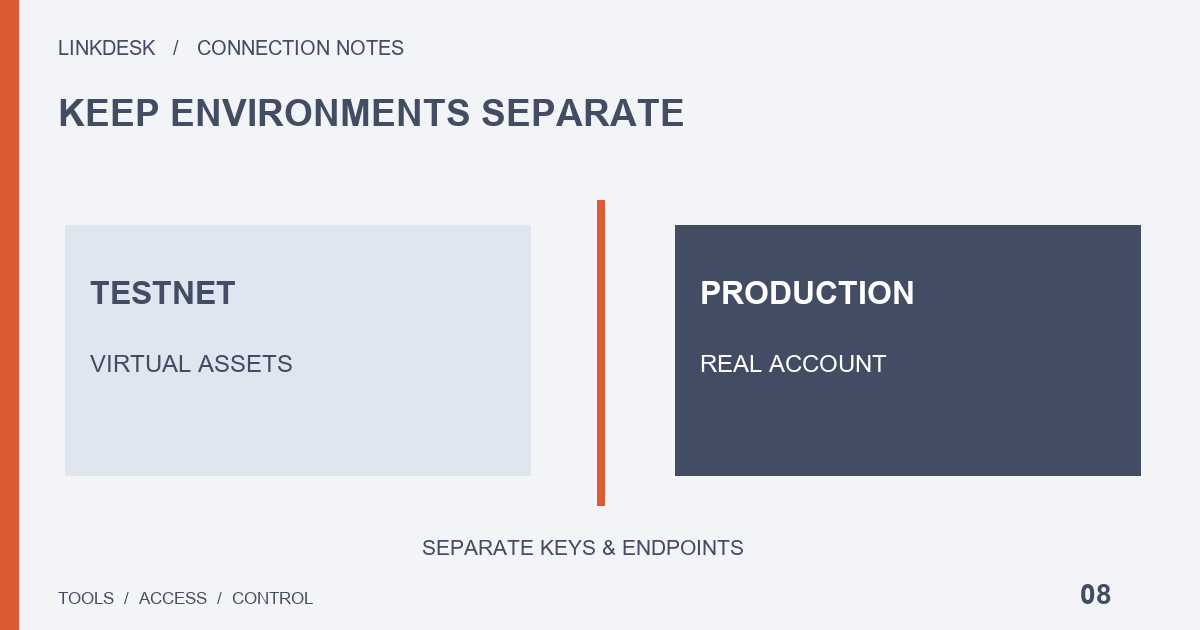
Spot Testnet assets are test data. A successful test does not establish that your production account is connected, and real deposits are not a repair step.
Define the result you need
A program parsing a response, a credential passing authentication and a dashboard showing your real assets are different outcomes. Write an explicit target such as “the test connection reads test balances and labels them simulated.” That outcome does not establish production access. A simple success badge hides too much when several environments and data sources are involved.
Keep four settings together
Review the API base address, credential environment, application mode and storage destination together. A visible mode switch may not control every background worker or cached dataset; check the implementation instead of guessing. For your own application, use unmistakable configuration names. For a managed tool, ask which components change when the mode switches and whether cached test data is stored separately.
Understand the balance difference
The official Spot Testnet guide describes virtual assets and periodic resets. Its balance is not a mirror of your production holdings or a withdrawable reward. If an amount changes unexpectedly, first check the test configuration and reset status. Do not send real assets to repair a test display. Keep test amounts out of personal wealth summaries and any performance claims.
Ask what simulation means
A provider may call an entirely local simulation “test mode.” Another mode could still read production account data while suppressing actions. Similar labels do not establish the same privacy boundary. Ask which service receives requests, whether personal data is read and where simulated records are written. Until the provider explains these points, leave the environment classification unresolved rather than promising complete isolation.
Verify without placing a trade
Run one supported read using the test configuration and record the environment label, response time and displayed dataset. Restart the tool and inspect whether those labels remain consistent. If separate saved connections are supported, give the test connection an unmistakable name. This checks identification, authentication, reading and presentation. A live transaction is unnecessary evidence for this connection task.
Review production separately
Stop the test job before introducing production data to the same dashboard. Recheck the account entity, service availability, credential type, minimum read scope and actual outbound address. Do not copy convenient broad test permissions automatically. Compare the first production result with the official account interface at approximately the same time, while recording data age and the particular account scope being read.
Make missing test data understandable
An empty screen after a reset can look like missing assets. A dashboard you maintain can identify test data as refreshed or reset and retain the last successful read time. Ask a managed provider how it handles that situation. Mark support evidence as test-environment material. Remove real balances and credentials from reproduction notes, even if the test request itself contains no real funds.
Limit your conclusion
A fast test response does not promise production performance. Complete test data does not establish coverage of every production account product. Record only the read and presentation behavior you actually checked. When adding a different account type or feature, create a new verification entry. That keeps a useful reusable process without turning an early green badge into a permanent guarantee.
Preserve environment labels outside the app
A test label visible on a screen may disappear from an export or cropped screenshot. Before sharing a demonstration, check that the file still identifies its source, creation time and simulated nature. A spreadsheet detached from its original page should not be mistaken for a real account statement weeks later. Use invented account labels for team demonstrations and share the configuration structure rather than working credentials. If several data sources already occupy one dashboard, inventory them before production use: test reads, manual imports and real synchronization should remain distinguishable.